M6 Props
Props appear on screen. A prop a character picks up is in their hand, at its grip, the
right size and the right way up. A prop put down stays where it was put. A prop handed
over changes hands as the hands meet. Until now the compiler only timed PropCues and
reported compile.prop_not_rendered: in the M5 watch-it the buoy never appeared, and in
the sixth the kettle and mugs were in the script but never on screen.
Read with docs/design/m1-compiler.md (timing, performance channels),
docs/design/m1-engine.md (the sampler, the card, the set builder) and
docs/design/m6-performance.md (gestures, stepping).
Where things stand
- EpisodeIR.
PropCuehas an action (hold, pick_up, put_down, use, throw, hand_to; (implementation) state, let_go in 1.12, and fly in 1.13), a prop, a hand and a recipient. It has no place, so "sets the kettle on the core" cannot say where. - PropInstance. A recipe in the kit-piece grammar, a palette,
holding(grips with a hand pose, a position and a rotation on the prop,heldScale,view) andstates. - Sets. A generated set can dress a prop: the set sampler copies its recipe into the
set's
piecesaskit.prop.<name>and places it like any kit piece, so the set builder draws it today. It cannot move. Hand-made sets use stand-ins: the Marigold bridge'skettleis a redprim.cylinderonkettle_shelf. - Compiler. A prop cue lasts 0.5 s and does nothing else.
- Engine.
RwRecipe.from_propreads a prop's recipe, and only a test builds one. The hand builder draws one prop of its own, the wrench ofwrench_wave. - Director.
ActionReaderreads "hands her the wrench" to bring the giver to the taker. It makes no prop cue.
The data
EpisodeIR 1.4. PropCue gains:
place: where the prop goes down (put_down, throw), or where it is picked up from when the set does not dress it:element:<id>(on top of it) ormark:<id>(on the floor).grip: one of the prop's grips. Default itsdefaultGrip, else its first.- (implementation)
state: the prop's state from the cue on, one of itsstatesordefault(its own params), with any action; and the actionstate, which changes only that, with no hand moving. The eighth watch-it's drone kept its eyes lit after its battery died, because nothing could switch a prop's state.
(implementation) A scene gains props: props that stand in it from its start, on an
element or at a mark, turned yawDeg, in a state, without being dressed in the set. The
eighth watch-it's showrunner made its drone visible by dressing the shared engine room with
it, so it stood in every episode on that set.
Timeline 1.5. Both additions are optional, so a Timeline without props keeps its bytes.
Actor.props: who holds what, when. One span per prop in a hand: the prop, the hand (left, right or both), the grip and its hand pose, from the frame the hand closes on it (startFrame) to the frame it lets go (endFrame).take: the arm reaches towardtargetMfrom the reach'sstartFrame, is there as the span starts, and is back at the reach'sendFrame.release: the same around the span's end (put down, handed over, thrown).uses: the hand lifts the prop totargetMand holds it there for a while.
Scene.props: each prop the scene uses.element: the set element that stands in for it. It is hidden while the scene plays.places: where it stands when nobody holds it, from a frame to a frame, as a point and a yaw. The point is the prop's origin, so its lowest point sits on the surface.flights: thrown (or (implementation) flown of itself), from a point to a point over frames, in an arc.- (implementation)
states: step keys, from each frame the state it is drawn in.
- At any frame of the scene a prop is in one hand, on one place, in the air, (implementation)
riding another prop (
rides, Timeline 1.10; see In or on another prop), or not on stage yet. The spans never overlap.
The compiler
Prop cues play in cue order, one prop at a time.
Where it starts.
- (implementation) Where the scene's
propsstand it, first: on an element's top (its middle) or at a mark, turned as the element or the mark is unlessyawDegsays. A stand-in the set has is still hidden. - In the set, when the set dresses it: an element whose piece is
kit.prop.<name>, else an element whose id is the prop's name (kettleforprop.kettle). That element is its stand-in, and the prop stands on the stand-in's base. - Else, when its first cue picks it up, at that cue's
place, else on the floor half a meter ahead of whoever picks it up. - Else in the hand of the first character who does anything with it, from the scene's start.
- (implementation) Where the scene's
pick_up. The character reaches for it and has it from then. From someone else's hand, it is taken from them.
put_down. They reach to the place and let go, and it stands there. Without a place: back where they took it from in this scene, else on the floor half a meter ahead.
hand_to. Both reach to a point between them, and it changes hands as they meet. The recipient takes it in their free hand on the giver's side.
hold. In their hand from the cue: taken, with a reach, from where it stands or from whoever has it.
use. In their hand, lifted in front of the chest for the cue. (implementation) EpisodeIR 1.15:
liftsays where else.mouthbrings the hand 12 cm before the lips,eyes30 cm before the eyes, andoverhead25 cm over the top of the head on the hand's own side, a little ahead. Only a use takes it (prop.lift_use_only). The director lifts a sip, a drink, a gulp or a slurp to the lips. The thirteenth watch-it's Captain had sipped her tea with the cup before her chest.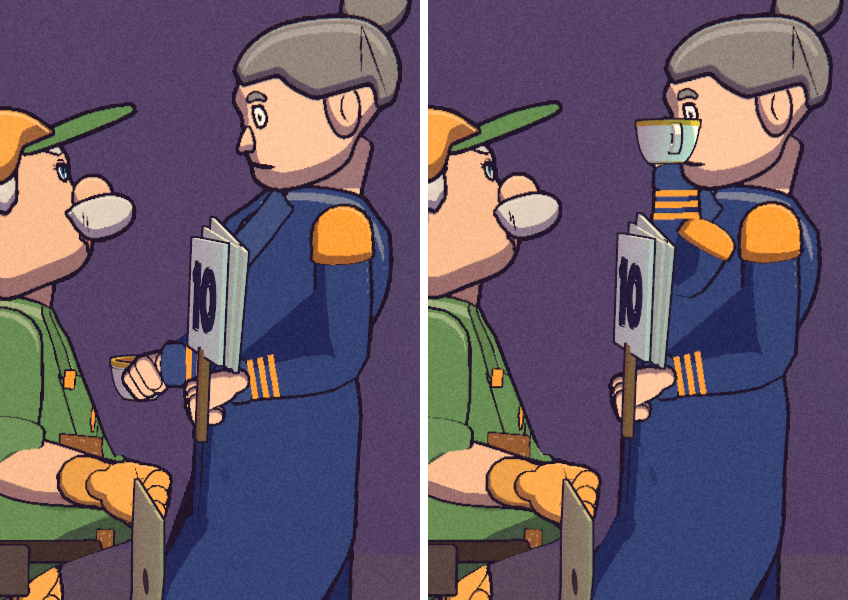
throw. It leaves the hand, flies in an arc, and lands in the recipient's hand, on the place, or on the floor ahead.
(implementation) let_go (EpisodeIR 1.12). The hand opens at 0.25 s, and the prop stays where its grip was. While a float is under way it hangs there, bobbing like a loose prop, until the float lands; then it falls straight down to the floor beneath (a flight with no arc, as long as a fall that far takes) and stands there. With no float it falls at once. A hand that takes it first takes it from the air. The director reads "lets go of the box", and a thing that leaves someone's hands of itself ("the music box bobs up out of the Captain's hands", "slips from her grip"), as a let_go by whoever holds it. The eleventh watch-it's box stayed in the Captain's hand through the hiccup.
(implementation) state. Nothing in hand, and no one need be on stage: the prop's state changes at the cue's start (a key in
states, kept only where it changes). A prop that stands nowhere in the scene changes all the same, unseen, withprop.nowhere.Hands. The cue's, else the hand that already holds it, else the right one if it is free, else the left. A two-handed prop takes both. (implementation) "The right one" is the hand on the side of what is reached for: the shelf on the Chief's left takes his left hand. A prop found in a hand from the scene's start takes a hand nothing else holds in the scene meanwhile.
Durations. A prop cue lasts as long as its business: pick_up and put_down 0.8 s (the hand closes or opens at 0.35 s), hand_to 1 s (they meet at 0.5 s), throw 0.8 s, hold 0.3 s, use 1.2 s.
Lying down. A prop's
restisupright(as built, the default) orlying: set down or placed, it lies on its side, a quarter turn round its forward axis, its middle over its place and its side on the surface (a wrench, a broom, a pipe; the eighteenth watch-it's wrench stood on its end). The compiler keeps its length as its footprint and reaches for its grip where it lies; the engine turns it (RwProp.rest_transform). In a hand or in the air it is upright as ever.Places. On an element: its top, kept a prop's radius in from the edge, and clear of whatever already stands on it by 3 cm rim to rim, the set's own pieces on it included (the bridge's kettle on its shelf), unless one stands in for a prop the scene has, which is wherever its prop is; where nowhere is clear, the least crowded spot. Only a level top holds anything: an extrusion's top follows its profile, and where it slopes more than 10° (the helm console's face, its screen on it) nothing stands, so things go on its flat back. On a kit piece, a thing stands on the part beneath it, up from the floor through the parts that touch: a stove's cooktop, not the top of its backsplash; a shelf's board, not the bottom of its brackets (the twentieth watch-it's pan floated 32 cm over the burners). An upright lathe holds things where it is solid straight up through the point: a bowl's floor, not its rim. Put down there, it goes beside the last thing put there, if the hand can reach that far (the saucer goes down by the kitten on the console); else at the point nearest the character. Stood there by the scene or flown there, it takes the middle, else the clear point nearest it. Points are tried 5 cm apart. On a mark: the floor there.
Diagnostics.
prop.not_holdable(a prop the show says cannot be held is picked up anyway),prop.unknown_grip,prop.not_held(used or handed over by someone who does not hold it: it is taken first; put down: it goes there all the same),prop.out_of_reach(the place is beyond 0.55 of the character's height, so the prop jumps),prop.missing(the compile was given no PropInstance for it: timed, not drawn),prop.in_doorway(a scene stands it on a mark within 1.2 m of a way in,Stage.doorway: whoever comes in or goes out walks through it). An unknown prop, grip, place or recipient is a validation error, and so is a hand-off with no recipient or to the giver.A move or a posture change no longer has to come first: prop business on an arm lets go of a held gesture on that arm, as a move does.
In the engine
- Built once per scene. Each prop of a scene is built from its recipe
(RwRecipeBuilder) the way a kit piece is: cel shading, silhouette ink and creases, its
colors from its own palette. The stand-in element is hidden.
- (implementation) The set builder and the prop share
RwSetBuilder.recipe_mesh. A prop keeps its full color where a set piece takes the style's quieter background color, and its auto-inked surfaces always take a silhouette, as a character does.
- (implementation) The set builder and the prop share
- Held. The card knows where it drew the hand. Each frame the prop's grip point goes
to that hand's grip point: in the palm, projected into the card, and carried into the
world as the card is. The prop stands upright in the holder's facing, turned by the
grip's rotation, at
heldScale(grown from its true size over the take).- (implementation) PropInstance first said a held prop is rendered to 2D from its
viewangle and drawn inside the card. It is drawn in 3D instead, beside the card: the set's light, shadow and ink reach it as they reach a set piece, and the camera sees it from the angle it is at, soviewis unused. Upright, not turned with the wrist, keeps a kettle the right way up whatever the arm does.
- (implementation) PropInstance first said a held prop is rendered to 2D from its
- In front of the card. It sits its own radius nearer the camera than the card, scaled
about the camera so its size on screen does not change, so the card never cuts it.
- (implementation) When the hand is behind the body (its grip more than 8 cm farther from the camera than the chest), it sits that far behind the card instead, so the drawn body hides it.
- (implementation) Never in front of another flat card drawn over it that stands nearer the camera than its holder: it comes no closer than that card, and if need be goes behind its own. The seventeenth watch-it's confetti cannon, a radius in front of the Chief, was drawn over Otto at his heels.
- The hand. While it holds a prop the hand takes the grip's pose: power_grip, handle, hook and two_hand curl round it; pinch is a fist; flat_palm is open. A one-handed carry bends the elbow so the prop clears the leg; a two-handed carry holds it in front. Reaches and uses steer the arm with two-bone IK toward their targets, by an eased weight.
- Not held. It stands on its place, flies along its arc, or is not drawn.
- Lamps and screens. (implementation) A practical lights a prop no more than it
lights what stands 0.6 m off it (
RwStyleMaterials.cap_practicals), however close the prop comes: the fourteenth watch-it's kitten, beside the helm screen, glowed white and mint. The set's own surfaces keep their pools. - Phones. (implementation) A phone (drawn from the library's phone, or named one)
shows on its glass what the scene's phone inserts show: the messaging app at rest (no
message, no one's name) until the first cuts in, then that insert's screen until the next,
cut from the insert's own graphic (
RwGraphicDesign.cut_toits screen block, grown to the glass's shape on the screen's color) and drawn by the sameRwGraphicDrawer, glowing, its corners rounded as the glass is (RwSceneProps). A decal in a screen finish is a screen of its recipe as a screen box is (RwRecipeBuild.screens), and the prop turns its picture so its top is the end the grip holds up. The library's phone holds its glass toward whoever holds it, so the screen shows from behind or beside them. Its glass was a blank color. What the action says a phone shows (It shows a text from Grandpa: "Come home.") is a phone's insert too, after the action (docs/design/m4-director.md, "Every message, however it is written"), so the phone in hand shows it from then on; it showed the app at rest. - Lights and beams. A recipe anchor of kind light with a
light(color, intensity,rangeM,coneDeg, each an expression of the recipe's params) casts a spot along its facing, tipped down by itspitchDeg: a flashlight lights the deck and the crates it points at, held or set down. A state that brings its intensity to 0 switches it off. A material slot of finishhazeis see-through and unlit, adding its color to what is behind it at its emissive times its color's alpha, with no ink: the beam itself. The nineteenth watch-it's flashlight lit nothing, and its beam was an opaque cone. Any other slot whose color has alpha (#D8F0F270) is cel-shaded and inked as usual but drawn over what is behind it at that opacity: a glass shows the water in it. The thirty-eighth watch-it's glass of water read as a white tumbler.- (implementation) The spot (a SpotLight3D, falling off as a practical does, without shadows) hangs on the state's mesh, so it shows and hides with its state. Card characters take only the set's key, fill and ambient, so it lights the set and the props, not the cast.
- (implementation) States. Each state a scene shows the prop in is built once, its
params over the prop's own (a state overrides params, as PropInstance says), and the one
its
stateskey says is shown, held or not. A state whose params hide every part (the twelfth watch-it's drone, "gone") shows nothing; it had fallen back to the prop's own look. - Stepping. The prop follows the drawn hand, so it steps with it. Which state a prop is
in is read at the frame stepped by
characterStep, as the actors are.- (implementation) A fast stroke drawn on ones (
fastActionStep) can show the hand at the shelf one frame before the prop leaves it.
- (implementation) A fast stroke drawn on ones (
- The sampler stays a pure function of the frame. (implementation) RwActorState carries
the props in hand (
props) and the arms' reaches (reaches, each with a target and a weight); a hand reaching for what it does not hold yet opens. Prop business counts as acting, so a fast reach may draw on ones.
The director
The heuristic director reads prop business from the action.
Whose, and how many. "His mug" is the mug whose id or name has a word of the subject's (prop.chief_mug for the Chief), "Otto's mug" Otto's, and "it" after them the same one; "three mugs whoosh into the air" flies every prop the words name alike. A thing a sentence carries on with another ("backs in, holding a tea tray with three mugs on it") rides it from the start, and a hand that takes a thing off a tray someone else holds walks up beside them first, and they turn to offer it (a body look at the taker as they get there, or as they take it when they are beside it already), or the far side of the tray is out of reach. The twenty-first watch-it's director took the Captain's mug for "his mug", flew no mug, and left them all nowhere. Someone's own, when every prop so called is another's, held or last let go and never theirs, is a thing of their own to make, called theirs: "Jada breaks her taco" once the only taco fell from Pip's hands is "Jada's taco", and "Pip's taco falls" while Jada holds the only one is "Pip's taco" (Lunch Rush's Jada broke Pip's taco off the floor). Taken back from whoever holds it ("takes her kettle back from the Chief"), or had before (the Captain's teacup, back out of her pocket after the Chief's trick), it is the one they hold.
Up and down. "The pancake shoots out of the pan, straight up, and sticks to the ceiling" flies it up against the ceiling (place
ceiling); "drops onto his plate" flies it onto the plate; "falls off the console", "slides off the console onto the deck" and "the pieces CLATTER across the deck" fly it to the floor beside where it was (placefloor), lying over when the prop has a state for it (toppled), and "off the console" is never off stage; "the pieces" or "the chess pieces" are every chess prop but the board, which stood on it and fall with it, a moment apart; whoever picks one up off the floor walks to the furniture it fell from first; a clause with a subject of its own is a flight of its own ("the board slides off … and the pieces CLATTER …"); a noun is no flight ("with a WHOOSH"); "takes a big bite" lifts what is in hand to the mouth. A thing that flies from nowhere named comes out of another prop the paragraph names, in it till then. A thing that acts of itself waits for what its paragraph did before it ("The Chief shuffles to the table and sits down. The pancake … drops onto his plate"). The twentieth watch-it's pancake flew the frying pan, its toast came in through the hatch, and the pancake landed while the Chief was still on his way.Striking. "Whacks the smoke alarm", "fans the alarm with it" (whacks, smacks, swats, bashes, hits, strikes, raps, fans): a use of the thing after "with", else of the thing in hand, on the piece of the set named (
PropBusiness.strikes). Whoever strikes walks within reach of it first, to a standing mark, else up to the piece where someone can stand by it, else the nearest mark; they face it, and a piece above 1.5 m is struck overhead. The twentieth watch-it's Chief whacked the alarm from the hatch, 3 m off.Between scenes. A prop in someone's hand as a scene ends is in it as the next starts, unless the next set keeps a mark named for it (a word of its id, its noun first: the hilltop's "basket" for the picnic basket), where it starts, put down; one in a pocket stays there; and what a scene leaves on its set (set down on a piece, tossed aside to no one, where the thrower stood, or never moved) is there when the next scene on that set starts. The nineteenth watch-it's hold, its lights back on, showed none of the tin and the cable its search had flung about.
Verbs.
- pick_up: picks up, grabs, takes, lifts, snatches, scoops up, fetches, hauls, pulls
out, fishes out, draws out, produces. (implementation) Taken out of a pocket, a
coat, a sleeve ("pulls an oily rag from his pocket"), or pulled out from nowhere named,
it comes out of their pocket (
place: "self", see "Pockets"), not off the nearest shelf. - put_down: sets, puts, places, plonks, leaves, drops (with a place: on, onto, in, into,
back on). (implementation) Pockets, tucks, stuffs, stows, and any of them into a
pocket, a coat or a bag: put away (
place: "self"). - hand_to: hands, gives, passes, offers (with a recipient).
- throw: throws, tosses, lobs, flings.
- use: pours, drinks from, sips, fills, uses, tightens, juggles. (implementation) With no thing of its own ("pulls out her teacup, and sips"), the thing just taken.
- hold: holds, clutches, carries, cradles.
- pick_up: picks up, grabs, takes, lifts, snatches, scoops up, fetches, hauls, pulls
out, fishes out, draws out, produces. (implementation) Taken out of a pocket, a
coat, a sleeve ("pulls an oily rag from his pocket"), or pulled out from nowhere named,
it comes out of their pocket (
How it is from the start. (implementation) A state said of a thing that stands there from the start, with nobody acting and nothing changed yet, and a verb of being ("Above the aft door, the air vent hangs dead"), is its opening state, not a change. The place may come first and the thing after it ("Above the aft door, the air vent…"), its last word the thing's own. "Plays a scratchy old waltz" still starts then.
Underfoot. (implementation) A prop that catches someone's foot or that they trip or stumble over ("Her foot catches the cable", "trips over the hose") lies on the deck at the mark where they stand then, from the scene's start, unless something else puts it somewhere. The twenty-first watch-it's cable was nowhere, so Otto tripped over nothing.
A prop as the subject. (implementation) A sentence that opens on one of the show's props ("The kitten climbs out of her pocket", "Her teacup slips") or on where it is ("On top of the crate sits a kitten, staring at her") is about the prop: the her and him in it are not the ones acting, so nobody sits or walks off. Only a let go (out of someone's hands) is done by anyone. A prop named in capitals is introduced, not a sound.
In order. (implementation) Business in a sentence that ends in an exit comes first ("scoops up the kitten, tucks it into her jacket pocket, and hurries out"), and a place ends with its clause, so the hatch she hurries out through is not where the kitten goes.
Two of a thing. (implementation) "Sets it down on the console" with two consoles takes the one the scene last put a thing on (the saucer goes by the kitten), else the nearest to whoever sets it down.
Which prop. The object of the verb, matched against the show's props by the words of their ids and names, as elements are. A thing the action handles that is no prop, character or element of the show is reported (
director.missing_prop), andepisode_needslists it with the props the outline names.What is a thing. (implementation) The fourth product audit's fresh shows made a "Hood", a "Piece" and the car's steering wheel as props, and never the lantern, the tray, the megaphone or the raccoon.
core/test/props-reading.test.tsscores 166 scene lines, each read in a new show of its own, cast and built by the reading's own fixes, for the props a person expects (test/fixtures/props-reading/).- Handled. Picked up, held, handed over, thrown or put down, a thing is a prop whatever it
is. Had with someone ("steps out of the trees with a lantern", "pokes it with a stick")
it is held already; covered or filled with it, it is not. A thing only worked where it is
("fills the tank", "opens the curtains") is a prop only when Reelwright draws it as what
it is (a library pattern or a kind,
director/thing-words.tsnamesThing); so is one of the verbs that work all sorts of things ("reads", "knits", "breaks", "scrolls on"), and never through "it" ("Bolt lights it" is the lantern in Mei's hands). What a pour fills, what a thing comes out of or sits on ("the candles on the cake"), and a thing that moves of itself ("A candy bar drops out") are things of their own. - Not a thing. A part of a body ("slaps his forehead"), what someone has on, theirs ("grabs his hood"; the show's own paper hat is still a prop), a part of a place (a door, the curtains, the floor), something done ("takes a nap") and a piece or an amount of a thing ("one piece" of the taco broken in half, "a slice of pizza", "a stack of books": the thing). A title's stop ends no sentence ("MR. KOWALSKI, sixties, … with a megaphone").
- The set's. A piece too big to carry is what its kit's words call it: the car's tags say
"steering wheel", so gripping it is the car's (
partOfSet), though a steering wheel is a kind of its own: a kind most often part of something bigger (Kind.part) is that thing's where the set has one. A thing someone owns ("drops her tray"), has with them, or picks up or holds named with "a" ("holds up a sign") is no piece of the set, nor is a piece too big to carry. A set built from the script leaves out what its people handle that a pattern or a kind draws, by the same reading of the action (placeDescription), and knows who acts in it from who speaks before they are cast. - Animals. An animal brought on in capitals ("A RACCOON waddles out onto the trail") is someone of its kind, a character the reading makes, not a sound; a kitten picked up is a prop.
- Handled. Picked up, held, handed over, thrown or put down, a thing is a prop whatever it
is. Had with someone ("steps out of the trees with a lantern", "pokes it with a stick")
it is held already; covered or filled with it, it is not. A thing only worked where it is
("fills the tank", "opens the curtains") is a prop only when Reelwright draws it as what
it is (a library pattern or a kind,
Where. The element or mark a put_down names, read as a walk's place is. (implementation) Things go on things: an element the phrase names wins over a mark ("on the helm console" is the console, not the helm mark).
Reach. A pick-up or put-down at a place beyond an arm's reach walks the character to the free standing mark nearest it first, else, with none in reach of it, up to the element itself (a move to
element:<id>, EpisodeIR 1.16; docs/design/m1-compiler.md, "Up to a piece of the set"). Reach to an element is to its nearest edge. A thing used that is not in hand ("the Chief fills the kettle") is picked up first, the same way. A hand-off brings the giver beside the taker: to a free mark within 1.6 m of them, else up to them (a move to the character, EpisodeIR 1.8; docs/design/m1-compiler.md, "Approaches"). The ninth watch-it's bridge had no free mark near the Chief, and a cable flew 6 m over the Captain. The prop cue waits for the walk.(implementation) A pronoun's business on a thing someone else of that pronoun holds is the holder's: "She holds up the scorecard again", after Otto's line, is the Captain's (the thirteenth watch-it gave Otto the scorecard).
(implementation) Several things in one sentence play one after another, and "it" is the thing before ("takes the kettle from its shelf and hands it to Otto").
(implementation) States. A sentence that names a prop and one of its states, by a word of the state's id ("the kettle boils":
boiling) or two words of its description ("the drone's eyes go dark": "Battery spent: its eyes go dark."), changes it, by whoever the sentence is about, else whoever is on stage. Words are compared by their stems. Words of place (on, behind, out, over…) never count, and a state's word said before the prop with a word of place between is something done to it, not its state: the fifteenth watch-it's Chief "works on the coffee machine" did not make it work, nor did "sinks out of sight behind the coffee machine" set it steaming. A sentence that opens on "it" or "they" and names no prop is about the prop the one before named: "The Chief backs into the crate stack. It comes down, toppling" topples the stack (the sixteenth watch-it's never fell), and so does one that opens "Then it…" ("Then it CRACKS"). Of the states its words fit, a prop takes the first it is not already in: "The egg WOBBLES. It WOBBLES again." rocks it one way, then the other (the twenty-third watch-it's egg leaned the same way twice, and never cracked).(implementation) Standing it somewhere. A prop the set does not dress, nobody holds and nothing has put anywhere stands where the action handles it: changed ("Otto opens the toolbox"), it stands from the scene's start where the sentence puts it ("the cartridge player on the helm console plays"), else, when it is taller than 0.8 m (a stack of crates), on the floor at the free standing mark nearest whoever changes it, else on the furniture nearest them (within 1.2 m), else on their mark (the scene's
props); taken up from no place the action names ("Otto lifts the music box"), it is taken from there. The eleventh watch-it's toolbox opened unseen (prop.nowhere), and its music box came from nowhere into Otto's hand.(implementation) They face what they reach for: a body look at the place comes before a pick-up or put-down. In the watch-it the Chief, turned to Otto for her line, reached behind himself for the shelf.
(implementation) The cover cuts to the giver and the taker together as a hand-off starts, and keeps that shot over a speaker's single too short to stand. In the watch-it Otto's "Hot!" took the hand-off's time, and the kettle changed hands below an MCU.
Flying
(implementation) EpisodeIR 1.13. The twelfth watch-it's cleaning drone hovered up out of a crate, zipped off through the hatch, whirred round the Chief's head and settled into the Captain's palm. A prop could only be put, thrown or let go, so its showrunner faked every trip with states: a "hovering" state that lifted every part 1.1 m, and "gone" to hide it.
- The cue.
flyis a PropCue with no character. It goes from wherever the prop is: standing (it leaves its place), held (the hand lets go as it leaves), or in the air (from where it hangs). It goes to one of:exit: an entrance of the scene's set. It flies to the doorway at 1.2 m and is gone until a later cue brings it back.recipient: a character. Into their hand, which reaches for it as it lands. WithhoverM, beside their head instead (0.4 m to their right, its middle level with their eyes,hoverMabove that), and it hangs there.place: an element or a mark, stood on it as a put_down would, orhoverMabove it. (implementation) Orceiling(EpisodeIR 1.20, a fly's alone,prop.ceiling_placeelse): straight up over where it was, its top at the set's ceiling, and stuck there, with no bob, until a cue takes it down. The director reads "sticks to the ceiling" so; the twentieth watch-it's pancake hung 40 cm under the ceiling, bobbing like a drone. (implementation) Orfloor(EpisodeIR 1.34, a fly's alone,prop.floor_placeelse): down on the floor beside where it was, out past the nearest side of the furniture it fell from (the room's side, downstage, of sides about as near), spread 0.1 to 0.45 m and turned by a seed of the cue and the prop, so a board's pieces scatter; a spread back into the furniture turns a fifth of a turn at a time (Stage.floorBeside). The thirty-fifth watch-it's chess board fell off the console out through the door.around(EpisodeIR 1.37): a character. It goes out from where it is to a circle about them at its own height, 0.7 to 1 m out, round itturnstimes (default 1), a leg every thirtieth of a turn facing the way it goes, and comes to rest where the circle began. A turn takes 1.6 s unlessdurationSecsays. The thirty-seventh watch-it's robot "spins in circles around the Captain"; its showrunner looped it round four marks it added.- none of these: it rises 0.6 m (or
hoverM) where it is ("hovers up out of the crate"). Come in through a door, it hangs 2 m into the room toward the middle of the stage.
enteris the entrance it comes in through when it is not on stage. A fly from nowhere without one isprop.nowhere, and it is not seen.- (implementation)
fromAbove(EpisodeIR 1.43) drops it in from straight above where it lands when it is not on stage: onto its recipient (head, shoulder or hand) or its place. The thirty-ninth watch-it's "a sock drops onto the Captain's head" had nothing over her, so its showrunner laid the sock on a pipe across the bridge and arced it off that, and it landed standing on end. Compiled as legs straight down (plan.falls): once the cameras are solved,liftFallshangs it just above the top of the picture of every shot its fall spans, straight over where it lands, at least 0.25 m up (and no higher than 12 m), so it waits unseen and falls into the shot from rest at half gravity, landing as the flight ends. It falls as it will rest where it lands, at its true size (the legs'resting, Timeline 1.20): lying when it lies down, its grip landing where it will be worn or placed, and hanging out of the picture by its grip's height over its lowest point as it rests. Into a hand it falls as it will be held, upright at its held size. The thirty-ninth watch-it's sock (rest lying) fell standing on end, a third bigger, and lay down across her head only as it landed. Validated: it needs a recipient or a place other thanfloorandceiling, and noenter,exitoraround(prop.from_above); on another action it isprop.fly_only.set_proptakes it (falsetakes it away). durationSecis the flight, default 1 s. Astatechanges as it leaves.- Compiled. A flight in the scene's
flights(the same track a throw uses: upright at its held size about its grip, unlessrestingdraws it as it rests, at its true size), arcing up to 0.15 of the distance, at most 0.5 m. It faces the way it goes across the floor. Then a place, a hold, or nothing. Hanging in the air (a hover, a rise, or a place withhoverM) it bobs 5 cm, a float span over its place. - Validated. A fly takes no character, and no other action may leave one out
(
prop.no_character). It goes one way only (prop.fly_ways;aroundis one).enter,exit,hoverM,durationSec,aroundandturnsare fly's alone (prop.fly_only), andturnsgoes witharound. An entrance the set does not have is an error. The compiler warnsprop.unknown_exitandprop.unknown_placefor what it cannot find. - The director. A thing that moves of itself: zips, zooms, whizzes, whooshes, darts,
flies, buzzes, swoops, hovers, glides, flits, soars, shoots; (implementation) and a
creature prop that climbs, clambers, hops, jumps, leaps, scampers, scurries, crawls or
pounces. Settles, lands and nestles
only fly into a hand ("settles into her palm"). The thing is the noun before the verb,
else the sentence's opening words ("the drone plucks the wrench from him and zips up the
ladder"); a character there is walking, not flying ("Otto darts to the helm").
- Into or onto someone's palm or hand: into their hand. Round, about, over or beside
someone's head, ears or face: beside their head (
hoverM0). - "In" or "in through":
enter, by the door it names, else the set's first. - Out through, off, away, up the ladder, is gone, vanishes, out of sight:
exit, the same way. Gone, it is not gone again until it comes back. - Out of or from an element: it stood there from the scene's start. To or onto one:
place. (implementation) Out of a prop ("out of the hamper"), or "out of it", the thing before: it was in that prop from the scene's start, and comes out of it. A prop it comes out of that has an opened state (hatched, open, empty, broken, burst, split) takes it then: the twenty-third watch-it's jellyfish "floats up out of it", and the egg is hatched. Out of a place the set has, it was in the prop standing there: the thirtieth watch-it's sandwich "floats up out of the basket", the hilltop's mark where the picnic basket stands. - (implementation) A thing that drifts, floats, bobs or wafts flies too, slowly, when the noun before the verb is what one of the show's props is ("a tiny glowing jellyfish floats up"), nobody floats with it, even one it drifts to ("drifts over to the Captain"), and no gravity or everyone goes before it: then it is a float, and "bobs up out of the Chief's hands" is let go of. In the watch-it, the jellyfish floating up out of the egg floated everyone on the bridge, and "Stars drift past the porthole" is still nobody's star chart.
- (implementation) Past a list ("drifts round the bridge, past the consoles, the kettle
and the porthole"): on to the last of them the set has. On someone's shoulder, or to
someone: beside their head (
hoverM0), as near a shoulder as a prop can be. - Zips, zooms, whizzes, whooshes, darts and shoots take 0.5 s; hovers, glides, soars, settles and nestles 1.5 s.
- Into or onto someone's palm or hand: into their hand. Round, about, over or beside
someone's head, ears or face: beside their head (
- Model director. The prompt and the scene context name fly, and
set_proptakes it withenter,exit,hoverManddurationSec. - Not done. It flies straight, in one arc, through anything in the way. It does not circle: "whirs round his head" hangs beside it and bobs. Nothing reads a prop's own lifting params. The wi12 drone's states still lift it 1.1 m, so flown, it flew 1.1 m too high until the scratch copy zeroed that param. Nobody looks at it in flight.
- Watched on lavapipe (
docs/images/m6/drone-flight.png): the twelfth watch-it's screenplay re-directed in a scratch copy. The drone rises out of its crate, flies in to the Chief and hangs beside his head, then flies to the Captain's palm.
Pockets
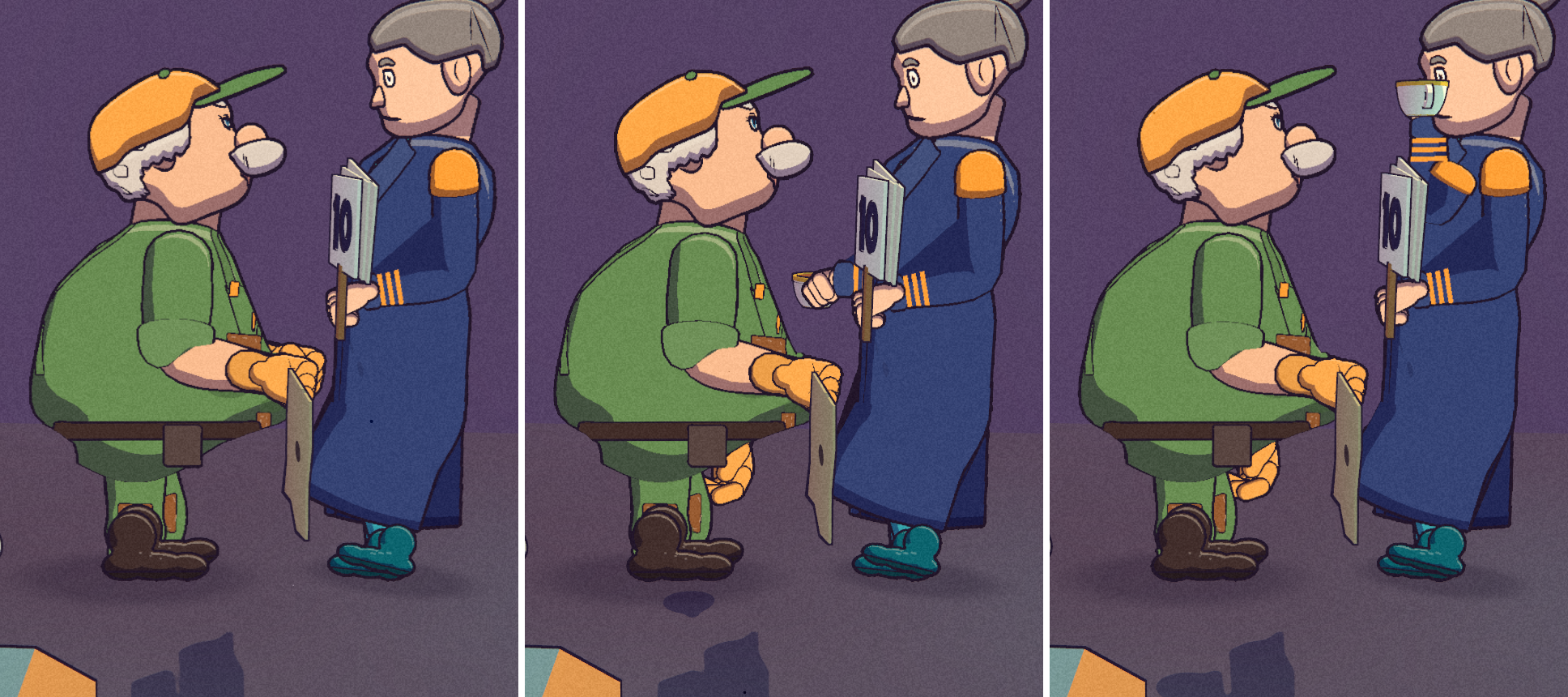
(implementation) EpisodeIR 1.14. The thirteenth watch-it's Captain found her vanished teacup in her own coat pocket. The Chief still held it, invisible, so the compiler had her reach 2.4 m across the bridge into his hand, and its showrunner restaged the trick to pass the cup to her at the POOF. The Chief's rag, "pulled from his pocket", was in his hand from the scene's first frame.
- The cue. A PropCue's
placemay beself: about the character's own person, a pocket, a coat, a bag. A pick_up or hold fromselfcomes out into the hand from wherever it was: off its place, out of someone else's hand (which is left empty, with no reach to give it), or from nowhere. Until then it is not seen. A put_down toselfputs it away: the hand goes to the hip and it is gone until a cue takes it out. - Compiled. The hand reaches to its own hip (the hip point, half a shoulder width to
its side) and closes there at the cue's contact. A
stateon it changes at that contact, not before, so a vanished teacup is not seen in the Chief's hand as it comes back in the Captain's. - Out of reach. A hand that takes a prop out of someone else's hand beyond an arm's
reach (0.55 × height) now warns
prop.out_of_reach, as one reaching for a shelf did. It was the wi13 reach, unreported. - Validated. Only a pick_up, hold or put_down goes in or out of a pocket
(
prop.self_place). - The director. "From his pocket", "out of her coat", "into his overalls" and "pulls
out" with nowhere named are
self, and so are "pockets the key" and "tucks the rag into his belt". A sentence that says a prop is gone, vanishes or disappears names a state called vanished, gone or disappeared, or one whose description starts so. A prop taken out of a pocket after it vanished comes out seen (state: "default"). A state change on a prop someone holds, in a sentence about no one ("The teacup is gone"), is the holder's. - Between scenes. (implementation) A prop still in someone's pocket when a scene ends is there in the next: the director puts it away again, out of sight, by its owner as the next scene first uses it. A flight from nowhere starts at the pocket it was put in ("the kitten climbs out of her pocket, onto the helm console"), not in through a door.
- Model director. The prompt names
place: "self"both ways, andset_proptakes it. - Watched on lavapipe (
docs/images/m6/pocket-trick.png): the thirteenth watch-it's first draft re-directed in a scratch copy. After the POOF the Chief holds only his rag; the Captain's hand goes to her coat and comes up with the teacup, and the Chief's empty hand drops to his side. Then she sips (a use lifted to the lips, EpisodeIR 1.15). - Not done. Nothing draws a pocket, and the hand goes to the hip whatever the sentence says (a sleeve, a hat). Two copies of a thing ("produces a second spanner") are still one prop.
In or on another prop
(implementation) EpisodeIR 1.19, Timeline 1.10. The twentieth watch-it's pancake could not be in its pan: a prop stood on the set or was held, so it waited on the stove beside the pan, flew up from there, and landed where the plate had been, not on the plate. Its toast flew out of nowhere, not out of the toaster.
The place. A
placemay be another prop,prop.<name>: a scene'sprops(the pancake in the pan from the start), and a put_down, throw, fly or pick_up. The prop goes in or on that one, its carrier, and goes wherever the carrier goes, carried, flown or set down, until a cue takes it off. Validated: a prop of the show, not itself (prop.on_itself).place_propandset_proptake it.Where on it. At the first of the carrier's seat anchors (kind seat) that nothing rides yet: a toaster has one in each slot, low enough that a slice pokes out of the top. Else on its top over its middle: the highest of its tops under the rider, at its middle and 70% of its radius round it, so a pan holds a pancake on its floor (1 cm up), not on its 5 cm rim (
recipeTopAtfollows an upright lathe's outline). With something there already, the next goes beside it where there is room on a level part wholly under it, feet 1 cm apart (70% of each one's radius: a mug's handle passes beside the next), points tried 5 cm apart nearest the middle; with no room, on what is there, a stack of pancakes. The twenty-first watch-it's three mugs stacked into a tower on its tray.create_propasks for seats on a thing other props go in.Compiled.
ScenePropPlacement.rides: from a frame to a frame, the carrier, the rider's origin in the carrier's own frame (offsetM) and its turn on it (yawDeg). Reaches for a rider go to where its grip is on the carrier at that moment: on its place, or at the carrier's grip in a hand. A flight out of a carrier starts there, and one onto a carrier ends where the carrier is as it lands. A carrier nowhere to be seen then isprop.nowhere, and the rider goes where a put-down with no place would put it.The director. A sentence that puts a prop in or on another the show has stands it there from the start: "A frying pan with a pancake in it waits on the stove" (the pan on the stove, the pancake in the pan), "Two slices of toast sit in the toaster". Put down or thrown "in the toaster" or "on the tray", and flown "onto his plate", it goes there while that prop is on stage; taken "off the plate" from nowhere else, it starts there. The hand goes to where the carrier stands. Whole words name a prop, so the pan is not the start of "pancake"; and a set piece the words name more of wins ("on the kettle shelf" is the shelf, not the kettle). Toast that shoots out of nowhere named comes out of the toaster its paragraph names, in it till then. The model director's prompt names
prop.*places.In the engine.
RwScenePropsplaces every prop that rides nothing first, then each rider on its carrier as it is drawn that frame (carrier.transform * seat, then the rider's own rest): held size and all, nudged toward the camera with it. Not drawn while its carrier is not; a ring of riders is never drawn.Watched on lavapipe (
docs/images/m6/props-on-props.jpg): the twentieth watch-it's breakfast re-directed in a scratch copy, its toaster given a seat in each slot. The toast stands in its slot until the SPROING; the pancake flips out of the pan in Otto's hand; and the Chief's hand comes down to it lying on his plate on the table.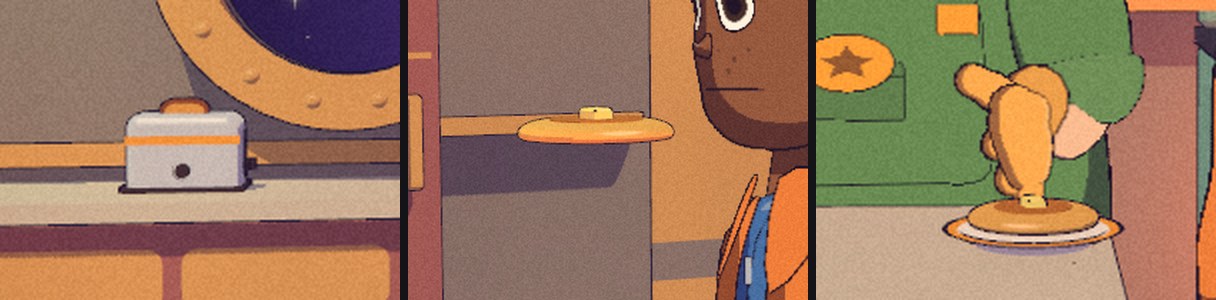
Not yet. A toaster without seats holds its toast on its top, not in it; nothing says how far into a thing "in" goes but a seat.
On a head
(implementation) EpisodeIR 1.22, Timeline 1.12. The twenty-first watch-it's "Otto's mug lands upside down on her head": nothing could put a prop on a head, so its showrunner flew the mug to her mark at head height, where it bobbed and only held while she stood still.
- The place.
head: a put_down puts the prop on the character's own head (a hat); a fly or a throw with a recipient lands it on theirs. Validated (prop.head_place), and a fly to a recipient's head counts as one way. - Compiled.
Actor.worn: from a frame to a frame, the prop on that actor's head. A put-down's hand goes to the top of the head; a flight or a throw lands there. A pick-up takes it off, the hand reaching to it, and a flight leaves from it. - In the engine. Upright on the top of the head as drawn, its lowest point on it,
(implementation) or on its side when it lies down (PropInstance
restlying, as it lies on a shelf: the thirty-ninth watch-it's sock stood on her head like a periscope), turned the wearer's way, at its true size, nudged toward the camera as a held prop is so the card does not cut it (RwCardFactory.head_top_world: the solver'stop_point, through the card's quad or the figure's frame). Not drawn while the wearer is not. - Down over it. (implementation, Timeline 1.18) One hollow underneath and wider than
the crown (an upturned bowl, a helmet, a bucket) comes down over the head instead, as far
as the clear height under it over the middle of the head and the crown either side
(
worn[].sinkM,sinkOverandrecipeLowestOver), no further than three quarters of the way to the eyes, in the deepest of the states it is in while worn. A lathe or a ring standing straight up or upside down covers only where its walls are. A mug narrower than the crown stays on top. The forty-first watch-it's upturned popcorn bowl sat on top of the Chief's cap like a lid. A hat comes all that way down however solid its recipe builds it, as a recipe builds every hat: its name's kind says so (overHeadincore/src/generate/prop/kinds.ts: a hat, cap, top hat, tricorn or paper hat, not a party hat, a crown or a book). Hat Day's tricorn sat on the Captain's hair, its solid crown kept on top, and the fourth product audit took it for a hat floating over her head. - The director. "Lands upside down on her head" flies it onto hers; "puts the hat on his head" puts it on his own. A state the action names goes with it ("upside down"). (implementation) "Puts it on" or "puts on her paper hat", with nothing after, puts a hat (its name says hat, cap, helmet, crown, tricorn…) on their own head; anything else stays in hand.
- Worn from the start. (implementation) EpisodeIR 1.25: a scene's prop may stand at
place
headwith awearer, worn from the scene's start wherever the wearer goes, in through a door too; validated (prop.no_wearer,prop.wearer_off_head), andplace_proptakes it. The director reads "sweeps in, wearing an enormous tricorn". The twenty-second watch-it's Captain wore hers nowhere. It reads too a thing said to be on someone's head or shoulder as they are, after a comma, "with" or "wearing" ("stands in the middle of the bridge, the sock on her head", "with a parrot on his shoulder"): worn or perched there from the start, "her" being the sentence's subject. The thing must end in a prop's own word, so "Suddenly, a sock lands on her head" is a landing, and "puts the sock on her head" puts it there. The thirty-ninth watch-it's last scene opened with the sock on the Captain's head, and she stood there without it. - Blown off. (implementation) What the wind carries flies, and nobody handles it: "a gust … lifts the tricorn clean off the Captain's head, and sails it across the bridge" flies the tricorn up off her head (not the Captain picking it up), and a paragraph that opens on "…" carries the last flight on: "...straight down onto the Chief's head" lands it on his. The gust comes out of what its clause says ("out of it": the vent the sentence before named), aimed at her head, with its WHOOSH; the hat goes up once the gust gets there (0.3 s after it), drifting toward whoever its next flight takes it to, and the beat lasts until it is up. It rose straight into the vent, before the gust came out.
- Framed whole. (implementation) The compile plans its props before its cameras, and a framing of someone with something on their head (an MCU, MS, MLS or LS) frames from its top, not the top of the head: the frame's top clears it by a little when the eye on its third would leave it out. The twenty-second watch-it's close shots cut off the Captain's tricorn. A close-up crops the head's top as ever: raised over Otto's paper hat, it kept the hat and lost her face. A set's own camera is as it was built, so the director takes none for a single that cuts off what is on its subject's head, and frames someone in a hat no closer than MCU while they wear it: after the tricorn landed, the bridge's camera on the engineering console and two close-ups said the Chief's last lines without it.
On a shoulder
(implementation) EpisodeIR 1.26, Timeline 1.13. The twenty-third watch-it's jellyfish "settles on the Chief's shoulder": a prop could go on a head and nowhere else on a body, so it hung beside his head.
- The place.
shoulder: a put_down perches the prop on the character's own shoulder, the side of the hand that held it; a fly or a throw with a recipient lands it on theirs, on the side it comes from. A scene's prop may stand atshoulderwith awearer, on their right shoulder from the start. Validated as a head is (prop.shoulder_place,prop.no_wearer), andplace_proptakes it. - Compiled.
Actor.worn[].on:left_shoulderorright_shoulder(absent for a head). The point is out from the chin to that side by three quarters of the half-width, a little below it (wornPointinprops.ts); a pick-up takes it off as from a head. - In the engine. On the top of the shoulder as drawn (
RwCardFactory.shoulder_top_world: the solver'sshoulder_point, through the card's quad or the figure's frame), upright, turned the wearer's way. A framing does not raise its top for it, as it does for a hat. - The director. "Settles on the Chief's shoulder" or "lands on his shoulder" flies it onto his; "puts it on her shoulder" perches it on her own. "Beside", "by" or "to" a shoulder is still the air beside it.
In the face
(implementation) EpisodeIR 1.30. The twenty-ninth watch-it's pillow "hits the Captain full in the face": a thrown thing could be caught, land on a head or a shoulder, or go down somewhere, so its showrunner landed the pillow on top of her head.
- The place.
face: a throw with a recipient hits them full in the face and drops at their feet. Validated (prop.face_place: a throw, with whose face). - Compiled. Two flights: from the thrower's hand to the recipient's eyes, then down, 0.35 s, to the floor 0.3 m in front of them on the thrower's side, where it lies until someone picks it up. Nobody catches it.
- The director. A thing as the subject that hits someone ("It hits the Captain full in the face", after "Otto flings her pillow at the Chief. The Chief ducks.") re-aims the last throw at them, in the face; a later "picks up the pillow" finds it at their feet.
Over a face
(implementation) Timeline 1.14. The twenty-ninth watch-it's pillow, dropped on the Chief asleep in his bunk, sat on the top of his head, past the end of the bunk, before "(muffled) That was a mistake." A thing worn on the head of someone lying sits where the top of their head points, beside it.
- Compiled. A throw or a fly at the
heador thefaceof someone lying face up (at least half into a lie as it lands) is worn over their face:Actor.worn[].onface. It stays there as they get up, until a pick-up takes it off as from a head; a framing does not raise its top for it. Lying, it rests on the front of the face at the eye line, 0.43 heads up from Metrics' eye; upright, its middle is before the eyes and its back against them, a radius out; between as they get up or lie down (wornPoint,lyingAtinprops.ts). - In the engine. The same, from the face as drawn (
RwCardFactory.face_world: the solver'sface_point, half the head's depth in front of the eye line, through the card's quad or the figure's frame), blended by how far into a lie the wearer is (RwSceneProps.lying). - The director. Nothing new: "She drops her pillow on the Chief" throws it at his head, and "pulls Otto's pillow off his face" picks it up.
A sound from a prop
(implementation) EpisodeIR 1.23. The twenty-first watch-it's CLINK, as the Chief's mug
landed back on Otto's tray, came from the Chief: a sound's source named a character, a
mark or a piece of the set, never a prop.
- The source. An sfx cue's
sourcemay beprop.<name>(SoundSource): one of the show's props, validated against them (ref.unknown_prop).set_soundtakes it. - Compiled. The clip pans from where the prop plan has the prop as the sound starts: in
a hand, on a head, set down, in the air or on what carries it (
propPointAt, which also places an effect from a prop). While it is nowhere,sfx.no_sourcewarns and it plays from the middle. Only the pan changes, so the Timeline does not. - The director. A sound in a sentence about a prop comes from it ("The wrench CLANKS", "The Chief's mug lands back on the tray, upright, with a CLINK"), and a sentence that is the sound alone comes from the prop the one before was about ("Otto's mug lands upside down on her head. BONK."). A possessive opening the sentence names whose it is, not someone acting: "The Chief's mug" is about prop.chief_mug.
Editing and previews
edit_episodegainsset_prop: add a prop cue (character, action, prop, hand, recipient, place and when), or move or change one by its id. (implementation) And astate; for fly, no character, andenter,exit,hoverManddurationSec; andplace_prop, which stands a prop in a scene from its start (the scene'sprops), moves it, or takes it out, without a change to the set.render_previewgains thepropkind: a small sheet of the prop on a plain stage, held by a character of the show and set down beside them, from the front and the side, then on the table in each of its states (up to six; the seventeenth watch-it's showrunner could see a cannon's smoke and confetti states only in episode stills). (implementation) Front and three-quarter: from the side, the table stood between the camera and the hand. The sheet is a tiny episode compiled like any other (core/src/studio/prop-sheet.ts), two cells to a row. (implementation) One that cannot be held stands on the table from the start, with no "Held" row (the meteor watch-it's crack showed a hand holding nothing). (implementation) One too big for the table, wider than two tables or taller than one in any of its states, stands on the floor at the holder's right instead, with no table, and the cameras stand back along their lines until it and the holder are both whole in the picture: the movie-night watch-it's 3.6 m screen stood on the table, most of it out of the picture.- (implementation)
render_previewgains thefxkind, for a show's effect: it plays from the top of a 1.2 m post on a plain dark stage, the camera stood back as far as the effect reaches (its fastest particle's longest flight, its glows' radii), in six frames across its length, three to a row, each captioned with its time (core/src/studio/fx-sheet.ts).create_fxpoints to it. The twenty-fourth watch-it's showrunner could see its meteor only by reading frame numbers out of a Timeline and asking for stills, and its first version was nearly invisible.
Prop patterns
(implementation) The second product audit's red lantern, made by the reading's missing-prop
fix, was the New prop template's brown box. Reelwright's library has prop patterns for the
things scripts handle most (engine/addons/reelwright/library/props/): a paper lantern, an
oil lantern, an umbrella, a phone, a mug, a spoon, a crate, a book, a bag, a bottle, a box, a
note, a kettle, a candle, a chest and a shop's roll-up shutter (pulled down, its state
down).
- Drawn. The sampler (
core/src/generate/prop/sample.ts) draws a variant, then each param's range (one the variant fixes is kept), the palette, wear and the pattern's rules over the prop, each from a stream named for it. A grip named as one of the recipe's grip anchors goes where the anchor is at the params drawn, so a big crate and a small one are both held by their sides. The prop records its pattern, seed and sampler inmeta.derivation. - From a kit. PropPattern 1.1
piecenames a kit piece: the prop's recipe is the piece's as the kit draws it, then the pattern's own parts after it (the crate's rope handles, the oil lantern's flame, the kettle's whistle, the candle's finger loop, the chest's handles), copied into the prop, as a set copies its pieces. - Matched. A script's thing is the pattern whose name or tags are its last words, the
longest match winning (
core/src/generate/prop/match.ts): "red lantern" is the lantern with red paper, "a camping lantern" the oil lantern, "a cup of tea" the mug, "a piece of paper" the note. A color word is its main color, "big" or "small" draws it so, and a word naming a variant picks it ("a gift box", "a ladle", "a teacup"). The show's own patterns come first. - From a kit piece. A thing no pattern answers to is the kit piece it is, matched by its
name and tags the same way (
core/src/generate/prop/piece.ts): the most of its words first, then a piece of a kit the show's sets are built from, then its own name before a tag. "The counter" is the diner's counter (the kitchen's in a show built from the home kit), "a lamp" the table lamp, "the telephone" the rotary one. The prop is the piece as the kit draws it, a length past 2 m brought in, its colors drawn from the kit's palette; held by its top, or in two hands past 0.35 m, when it is no wider than 0.7 m nor taller than 1 m, else not held. Walls and floors are never things. A piece too big to carry (a car, a counter, a row of shelving) answers to its own name and a tag that ends it (the kitchen counter's "counter") alone: its other tags name its parts and what it holds, and framing-score found Road Trip's Mom gripping the whole car its tag "steering wheel" had made. (implementation) Nor does the director put in a hand a prop no hand holds (holding.holdablefalse) and far bigger than a hand holds, over 1 m³ (HELD_MAX_M3): whatever the action does with it is a hand on it where it stands, and one standing nowhere is not staged (director.too_big). A tarp, or an open umbrella bigger only round its canopy, is still held. - Kinds. (implementation) The fourth product audit's fresh shows drew every thing
outside the patterns as the template's wooden box: the ferry's dented thermos, brass coin
and flashlight, the volcano's jug and its volcano. Measured over the staging corpus's
scripts and the audit's shows, 178 of 291 handled things were boxes. About a hundred kinds
of the things scripts handle most are built from parts instead
(
core/src/generate/prop/kinds.ts, the parts inshapes.ts): vessels turned on a lathe (a thermos with its cap, a jug with a handle and a lip, a jar, a bucket with its wire handle, a teapot), flat round things (a coin, a plate, a pancake stack), balls, rods built upright and lying down when set down (a pencil, a broom, a sword, a wrench), tubes along the line of sight (a flashlight with its beam, a telescope), slabs held up to be seen (a newspaper, a scorecard), soft things, hats, cases and machines. A kind answers to its name and its other names as a pattern does; it is made into a pattern for the sampler, so it is seeded, sized a little either way and held at its grips, and the prop records no derivation (there is no pattern file to derive it from again). A pattern answering to as many of the thing's words comes first; then a piece of a kit the show's sets are built from, named as well (the living room's own teddy bear); then the kind; then any kit's piece its words name more of. - Words. A thing's other words shape it and say what it is made of
(
core/src/generate/prop/words.ts): tall, short, flat, long, wide, thin, round, big, tiny and the like stretch it ("a tall jar", "a giant snowball"), "with a lid", "with a handle", "with a spout" and "lidded" give it the part, and wood, metal, brass, glass, china, paper, leather and the rest are its material (PropInstance 1.1), on a pattern, a kind, a kit piece or a box alike. The colour a material says is its main colour only when it is not what the thing is made of anyway: "a wooden spoon" is wood-coloured, "a metal bucket" may still be a painted one; a colour word always is. A material in a name stays the name's: "a paper lantern" is the paper lantern, made of paper. A thing only its shape words describe is built from them ("a round metal gadget" a ball, "a long wooden thingamajig" a rod, "a gadget with a handle" a case). Only a thing nothing describes is the template's box, in the colour and material its words give.core/test/words-props.test.tsscores 134 things as scripts and the audit name them (all drawn as their kind, colour and material), andcore/test/prop-kinds.test.tsholds every kind's prop together. - Made. The reading's "Make a prop called …" and "Make all N missing props", Studio's New
prop,
generate_props, andfill_needsfor every prop an episode's outline or screenplay needs, all draw this way, seeded by the thing's name.
Watch it
A scratch copy of Marigold: the Chief takes the kettle from its shelf and hands it to Otto. Directed with the heuristic director, rendered on lavapipe, with stills of the hand-off.
(implementation) The bridge has no mark within reach of the kettle shelf (the nearest is
two metres off), so the copy gave it two: galley, at the shelf, and near_center, a step
from the middle. Directed, the Chief turns to the shelf, takes the kettle (it leaves the
shelf as his hand closes, at its held size a moment later), carries it hanging from his
hand, walks over and hands it to Otto in a two-shot; it changes hands on the frame the
hands meet, and hangs from hers to the end.