A phone's messages, before and after
Product audit 5 (#12) found that an insert showed one message and that the phone prop's screen
was blank. The branch phone-inserts (batch 16, 6f03cd0ad) fixed how the director reads a phone's
words (docs/design/m4-director.md, "Every message, however it is written"). The engine did not
change: the phone in someone's hand already showed the scene's latest phone insert on its glass
(docs/design/m6-props.md, "Phones"). What the phone shows depends only on what the director
reads.
These stills show the change on one scene. The demo show was given the phone prop
(core/test/fixtures/director/red_lantern/phone.prop.json), and the scene was directed with no
model (reelwright direct --heuristic). It was drawn with reelwright stills --estimate-takes
on lavapipe at 1920x1080:
- Before: 32e92595b, batch 16 just before the phone-inserts merge.
- After: eee620293. The batch head at 60c00aa2a directs the scene to the same episode, byte for byte.
INT. MARIGOLD - BRIDGE - SHIP NIGHT

Otto sits at the helm. The Chief works at the console.

Otto takes out her phone.

INSERT - OTTO'S PHONE

"Where are you?"

"The lighthouse is moving."

"Call me."

BACK TO SCENE

OTTO
Chief, the lighthouse is texting me.

CHIEF
Lighthouses don't text, kid.

INSERT - OTTO'S PHONE

CHIEF (TEXT)
Look behind you.

OTTO (TEXT)
Very funny.

BACK TO SCENE

Otto holds up her phone. It shows a text from the Lighthouse: "Turn back."

OTTO
It knows my name.

CHIEF
Then answer it.
The inserts
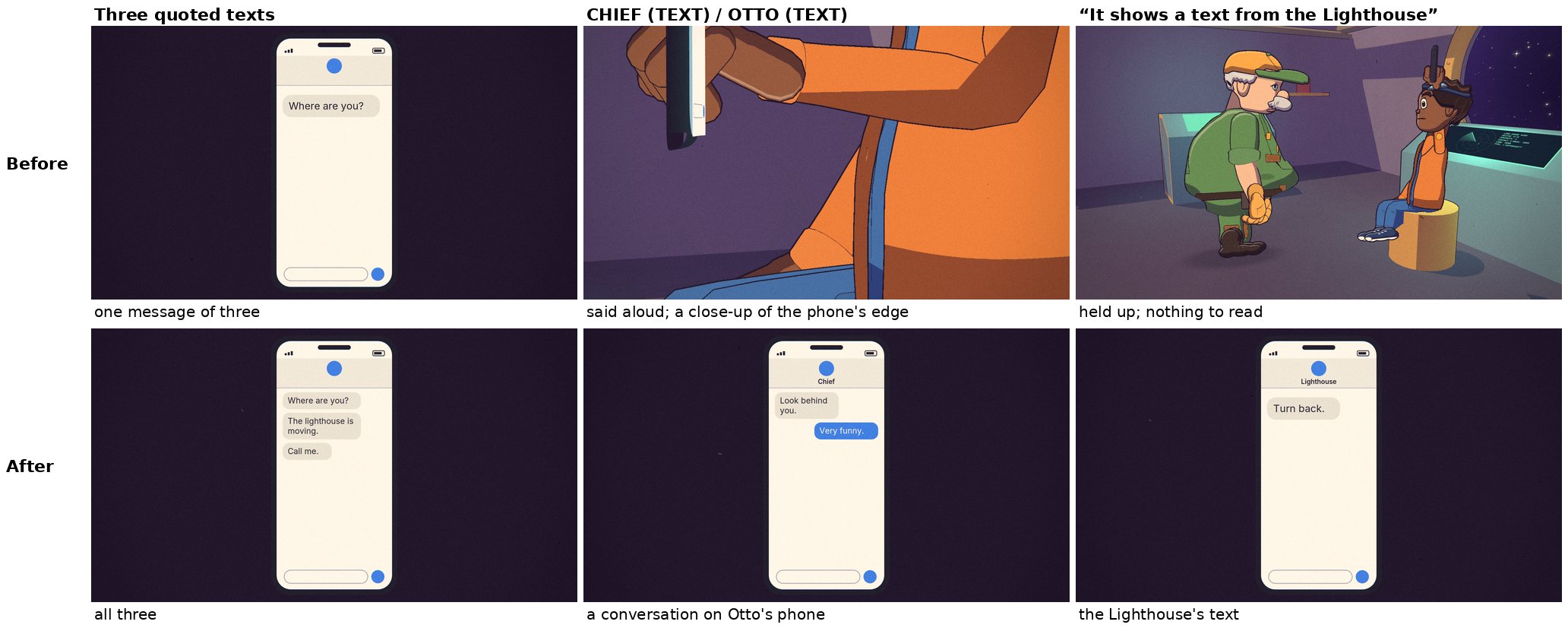
- Three quoted texts. Before, the card showed the first text, and the other two were left as action that staged nothing. After, it shows all three.
- The (TEXT) cues. Before, the Chief and Otto said their texts aloud, and the INSERT became a close-up of the phone's edge. After, the texts are a conversation on Otto's phone: the Chief's on the left, under his name, and hers on the right in the accent colour.
- "It shows a text from the Lighthouse: "Turn back."" Before, Otto held up her phone and nothing showed the text. After, the action is staged as written, then the scene cuts to her phone with the Lighthouse's text.
The phone in her hand
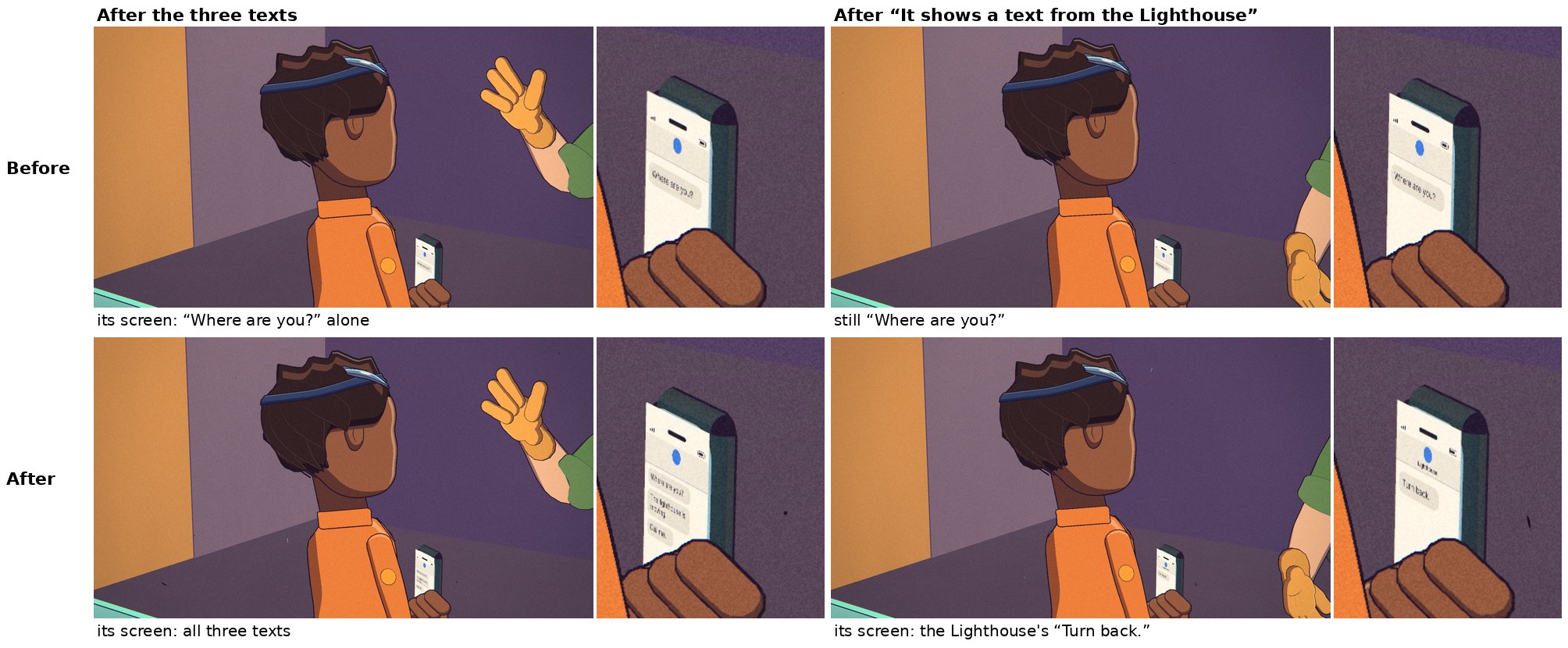
The phone's glass faces whoever holds it. From the director's own coverage, Otto's phone shows its back. To see the glass here, the Chief's two lines were played from behind Otto, looking down. Studio's shot inspector can do the same (set_camera: a medium close-up on Otto, turned 150 degrees round, from high, crossing the line as written). The same camera is used before and after.
The glass beside each frame is enlarged from the same frame. Before, the phone kept the first text alone, because that was the only message any insert had: the other texts never reached it, and neither did the Lighthouse's. After, it shows all three texts, and then "Turn back."
Not changed
- No golden moved. Nothing the goldens draw changed between the two commits: the stills, the
style swatches, the alpha golden and the places come from committed episodes and the engine,
and the only change under
core/srcorengine/addonswas the director's reading (core/src/director) and the review page. - The camera insert on a phone in someone's hand,
INSERT - OTTO'S PHONEwith no words under it, still frames beside the phone, and the drawn hand can cover the glass. It aims at where the compiler puts the hand, not where the card draws it. This is still open.